
The anatomy of ice cream – what is behind the scoop?
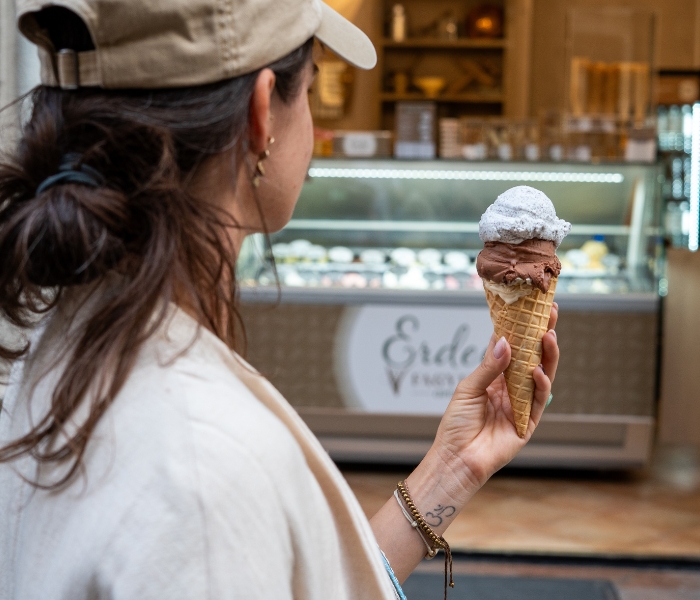
Ice cream lovers in Budapest seek mythology in ice cream, yet the paradox of the best recipes is that what is perfect is often infinitely simple and pure. The magic lies not in the complexity, but in whether the flavor has a story: what family memory inspired it, where the pistachios came from, who grew the peaches. Artisan ice cream shops provide exactly this authentic simplicity – with natural ingredients and sincere stories.
In recent years, artisan ice cream shops have become indispensable players in Budapest's gastronomy. The term "artisan" is not just a marketing trick – strict criteria define what can truly be called artisanal ice cream. Special care, a work process guided by expertise, unique craftsmanship, and the absence of artificial additives are all part of this philosophy.
Returning to Basics
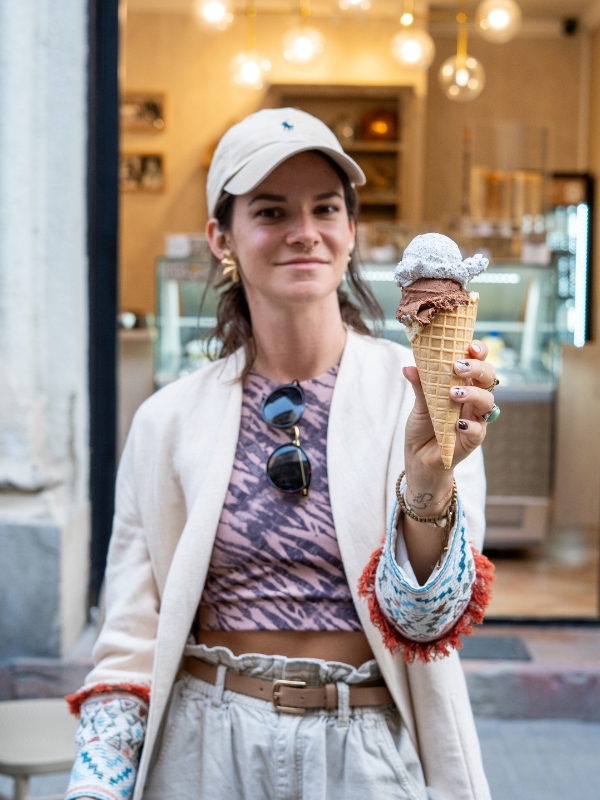 “For us, quality is not an optional feature, but a basic requirement" – defines the philosophy Nóra Erdei, one of the owners of Erdei Fagyizó, who, along with her husband Tamás Erdei, has built a thriving ice cream empire with four locations across the country. Their story – told on the terrace of their ice cream shop on Hajós Street next to the Opera House – perfectly reflects the trend we see in Budapest today: a return to natural ingredients.
“The sour cream cheese dumpling ice cream is made from sour cream and cheese. The strawberry ice cream is made from strawberries and therefore tastes of strawberries. You can use flavoring, but it won't be the same. You can tell it with your eyes closed" – explains Tamás, who switched from a degree in economic engineering to ice cream making, while Nóra had previously worked in health development.
The decision was made during a 900-kilometer El Camino pilgrimage. “I had a wonderful grandmother who baked for the whole village, she had very good recipes, the old handwritten recipe books and checkered notebooks from her still exist today. Today, these flavors provide the special range of Erdei alongside the big classics: bird milk, poppy seed bread pudding, sour cream cheese dumpling."
Many fateful coincidences led to the opening of their first Gyömrő location in 2021, followed by the opening of the Hajós Street unit, then one at Vizafogó and Lövőház Street as well.
Our production facility has been set up in the hundreds-year-old peasant house in Csoma, where Tamás grew up – specifically from the stable. “Where cows used to be, now the ice cream is made from fresh producer's milk,” he tells with a laugh.
A similar path was followed by Dániel Bezerics, the entrepreneur behind the Tompa Street Tompa17 Café, whose ice creams are built around a childhood memory. “At the end of the 80s, the flavors of the Jordanics Confectionery in Keszthely burned into my memory. The whole town went there for ice cream, long lines snaked there. To this day, I search for that kind of pure, honest ice cream where everything is what it is. There are no various foaming agents added, just cream, eggs, sugars, vanilla, and fruit."
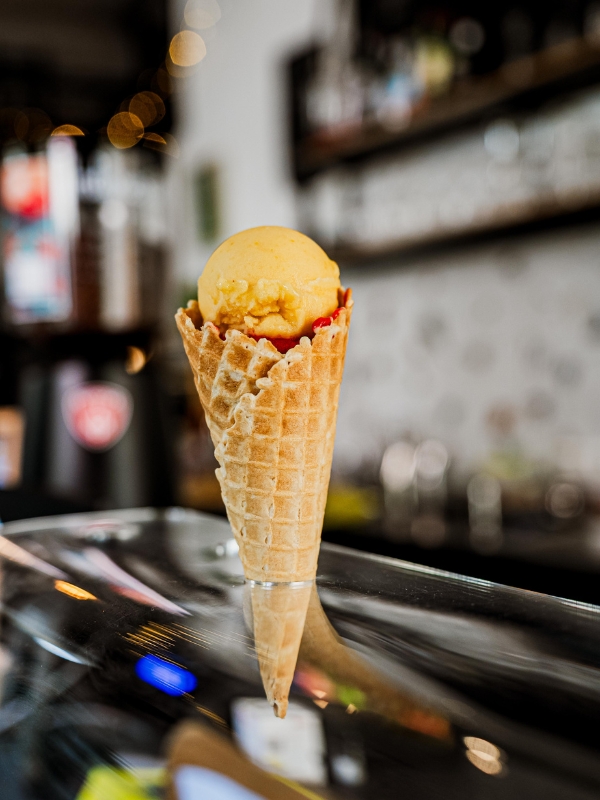 In his offer, alongside peaceful vanilla, peaceful chocolate, Sicilian pistachio, and salted caramel, there are rose pepper cherry and lavender apricot sorbet. The vanilla ice cream is especially important to him: “I think of vanilla ice cream as something like the margherita for a pizzeria - it tells what a person thinks of themselves and ice cream in general.”
Technology vs. Tradition
One of the most interesting questions in ice cream making is how much the technology has changed over the past decades. The history of Hungarian ice cream is an exciting evolution. The egg-cream, ice-cooled café delicacies of 19th-century Budapest followed the era of Northern Italian ice cream masters who settled in Hungary in the 1920s. They introduced the gelato culture: the milk-based, creamy texture and the impressive, display-case offerings. The era of nationalization brought simplified recipes – ice cream was made with artificial flavors instead of milk and cream. From the 1960s, twist ice creams made from powder and water also appeared. After the regime change, slowly, but especially in the 2000s, alongside the development of gastronomic culture, quality artisanal ice creams returned: made from fresh milk, real fruit, with less sugar. We could say: we have returned to the basics.
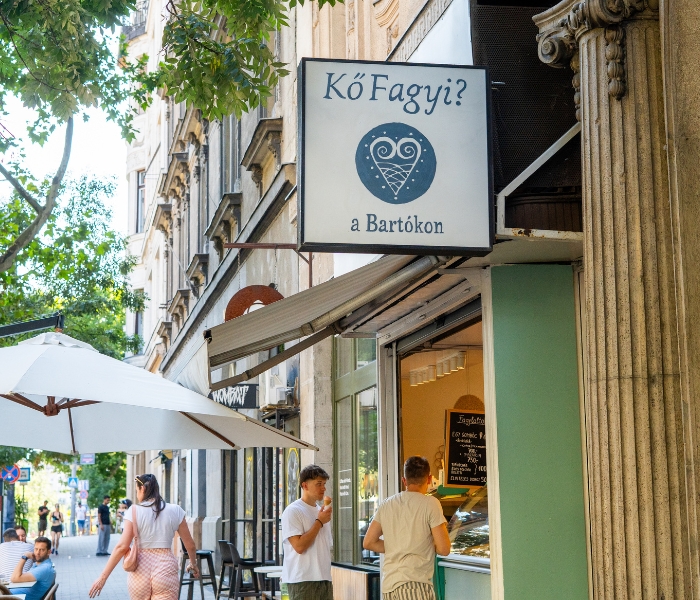
The legendary Kőfagyi needs no introduction in Budapest – the story of the ice cream shop founded by Ferenc Biszku and Krisztina Varsányi in 2007 began in Mindszentkállá, influenced by a Piedmont experience. Their latest unit opened at Rákóczi Square under the name Főfagyi, in a former Tehertaxi business location. “Our technology is infinitely simple – says Gábor Rákár, co-founder of Kőfagyi. – The milky ice creams need to be cooked, so the upper part of our machine cooks, while the lower part freezes on a cooled plate, that's all there is to it."
This simplicity, however, does not mean a compromise on quality. Artisan ice cream is distinguished from the non-artisan by the fact that the latter uses powders and foaming agents. “Delicious ice creams can be made from powder because chemistry takes care of that. The only problem is that although raspberry will taste like raspberry and chocolate will taste like chocolate, they all have the same underlying taste because they are made from one base. In artisan ice creams, we work with 11 different, natural bases – the base for lemon ice cream is different from that of coconut, and different from coffee.
Finer than Music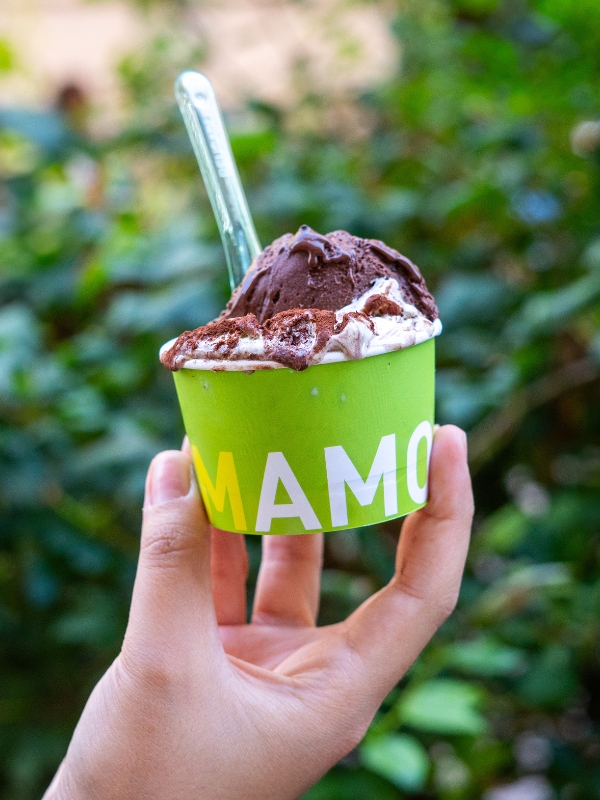
“The evolution of technology does not equal the decline in quality, quite the opposite” – says Nóra Erdei. “With modern, professional machines that cut the fat droplets differently and aerate the mixture differently, we can use the properties of natural ingredients even better. Old ice cream machines are beautiful, they look good and of course, you can make good ice cream with them, but we vote for modern equipment, especially energy-saving ones.
However, the ice cream has one more special ingredient: Tamás's singing. “Tomi's family is a real singing dynasty, they are connected to the Opera House in many ways, his father sang in the choir for forty years, and his grandfather was a soloist. That's why it was fateful for us to find a business location here” – Nóra recounts. “I was also preparing to be a tenor, but in the end, I became an ice cream maker - takes over Tamás. “Now I sing to the ice creams, mostly Italian songs, because I love Italian music. Somehow these energies transfer into the ice cream too” - adds Tamás with a laugh.
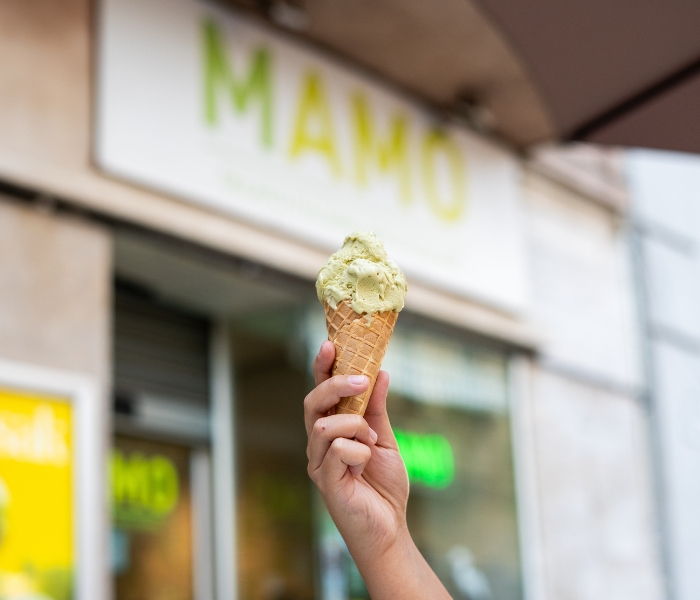
Judit Cselik, the manager of the MAMO ice cream shops, who has lived in Italy for many years, shares that for them, the technology has not changed much; they work with the same traditional methods as before. “Maybe when we recall our childhood, that ice cream wasn’t as creamy. But the Italians, for example, have been making ice cream the same way for 40 years, with the same machines. I’ve been to small factories in Italy where they had really 40-year-old machines that worked beautifully.
Local Flavors, Global Trends
Budapest ice cream shops have created an interesting balance between local traditions and international trends. The MAMO ice cream shop, for example, consciously represents the Italian gelato line. “Our guests are looking for classic Italian flavors, the pure tastes" – says Judit Cselik, who has been managing the units on Ráday Street and Tompa Street for seven years.
At the same time, Hungarian flavors also appear – albeit cautiously. Kőfagyi brings back the past with its rowanberry ice cream, while Erdei Fagyizó offers bird milk, poppy seed bread pudding, and sour cream cheese dumpling flavors. “We didn't adjust to market demands in this, but rather to our own internal needs to create the flavor world I inherited from my grandmother” - Tamás recounts.
Chocolate and Volcanic Eruptions
Quality ice cream making is inseparable from conscious sourcing. In the case of Kőfagyi, seasonality and local sourcing are particularly emphasized: “We tell what we get from where. We get peaches from Piroska néni in Zánka, and the figs are our own. Just the day before yesterday, I picked rowanberries, my hands are still purple from it." This transparency is also a marketing tool – guests like to know what they are eating.
However, the rising prices of ingredients are felt everywhere. “The price of chocolate has doubled in a year. Weather, volcanic eruptions, everything influences it. Sourcing through small producers is always more stable" – reports Tamás.
Free-from as a Challenge
Today's guests are much more conscious and demanding than before. Gluten-free, dairy-free, and sugar-free options are now considered basic expectations. However, the issue of being free-from is far from simple.
“Ice cream is fundamentally gluten-free" – explains Judit Cselik from MAMO. Dairy-free options are not an issue for fruit ice creams; moreover, their dark chocolate is also sorbetto, meaning made on a water base. Sugar-free is the real challenge since one of the fundamentals of ice cream making is balancing sugars and fats. “Something has to be put in, but it is very difficult to find a sweetener that does not compromise the ice cream's taste. Moreover, everyone reacts differently to different sugar substitutes; some are sensitive to maltitol, others cannot stand stevia, and again others find erythritol unsuitable.”
At Kőfagyi, Gábor Rákár also experiences the changing demands: “We were the first here in the area to offer free-from ice cream. At first, one, then two, then four, and now eight. Now, about a quarter of the counter must be sugar-free." What is sugar-free is mostly dairy-free for them; they use freshly made nut milks for the ice creams, coconut with coconut milk, Iranian pistachio with cashew milk, almond with almond milk, and walnut with walnut milk.
At Erdei Fagyizó, a pragmatic approach is applied. “We are not a free-from place, that is not what matters to us, but rather naturalness" – emphasizes Nóra. “We pay attention to having one of the 16 flavors always being sugar-free, as this can be helpful for a diabetic who wants to eat a good ice cream.” – adds Tamás. “Something is not healthy just because it is gluten-free, but because it is as minimally processed as possible.
The Eternal Favorites
Every ice cream shop has flavors that simply cannot be removed from the offer. “Pistachio, chocolate, lemon. No matter what we come up with, this is the top three" – lists Tamás the hits of Erdei Fagyizó. “They are closely followed by strawberry, cheese dumplings, bird milk and salted caramel. We also have specialities like cherry soup, blueberry cheesecake, or Rákóczi cheese cake that sell well.”
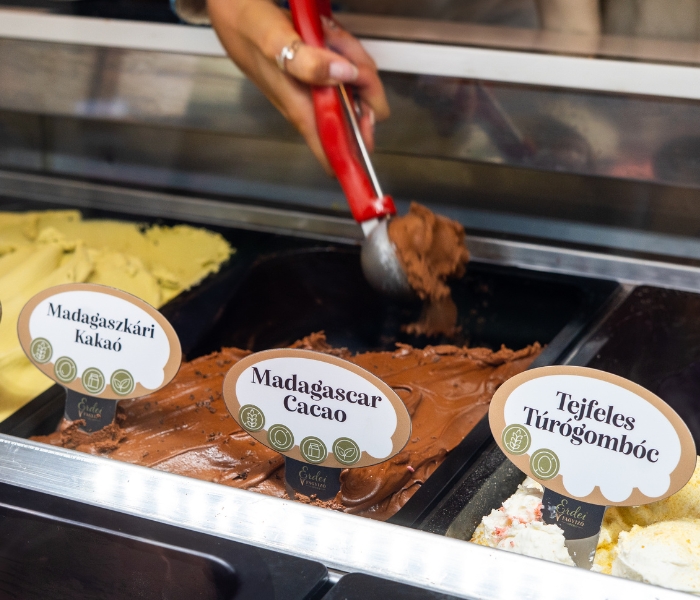
At MAMO, the situation is similar: “Pistachio is definitely in first place, but dark chocolate is also a big classic, made from real chocolate. Among fruit ice creams, mango and mint lime are the favorites, especially during heat waves.
“At Kőfagyi there are customers that if they peek into the counter and see there is no pistachio, they ask: is there no ice cream? Even if there are 18 other flavors there” – shares Gábor. “Pistachio, salted caramel, mango, lemon, these must always be there.”
However, experimentation is an important part of growth. Kőfagyi's cucumber and Aperol Spritz ice creams have become two large crowd favorites, real hits in warm weather. Wine ice creams are also popular, a third of which is really wine. “You can eat as much as you want, you don't feel it, but after two you shouldn't drive. Just for safety” – says Gábor.
Erdei Fagyizó has also experimented with bacon plum and salted butter corn. “We usually stay open until October, at which time the spicy flavors also come out: gingerbread, candied cherry marzipan, pumpkin, honey chestnut, maple syrup pecan.”
Every entrepreneur tries to keep an eye on trends but prioritizes authenticity in shaping their offer. During the Dubai chocolate craze, most shops did not make ice cream in that flavor, but they all noticed the growing popularity of pistachio, which is already among the most popular flavors everywhere.
.jpg)
Present and Future: From Seasonality to Continuity
When asked about this season, most entrepreneurs spoke of a weak start. “This sector is heavily influenced by the weather – highlights Judit Cselik. – In the profession, we know that the two strongest months are May and June and this year, the weather practically nullified May. Last year was excessively warm, traffic was good from the end of April to September because there weren’t longer cool-rainy periods, so this year we feel the difference more.
Most ice cream shops still operate seasonally, but this is starting to change. Erdei Fagyizó is experimenting with units that are open all year round, as they see this as a way to create a good team and maintain stable quality. “You can't build a big business solely seasonally" – concludes Tamás.
Kőfagyi temporarily hands over the business premises on Bartók Béla Street to their friends from the La Téne confectionery in Badacsony during the winter period, who will operate there pop-up style until March.
The Budapest ice cream culture has now reached a turning point. After the powdered ice cream era, we have returned to natural ingredients – not merely out of nostalgia, but as a conscious decision. These ice cream shops are not just selling sweets: they offer identity, a community experience, and a cleaner, more honest relationship with food.
As Gábor Rákár, the founder of Kőfagyi, says: “If it's good on its own, then it’s good; if not, no matter how you advertise that it is good, it won't be good.” This simple truth guides the best ice cream makers in the city today – and it’s why a summer in Budapest would be unimaginable without the passion and belief behind the scoops.
A shorter version of the article was published in the August issue of the Quality Wines Food, Lives Magazine, below the current issue of the magazine can be downloaded: