Sustainable tourism in Budapest – why thematic streets could be the key areas of the future?
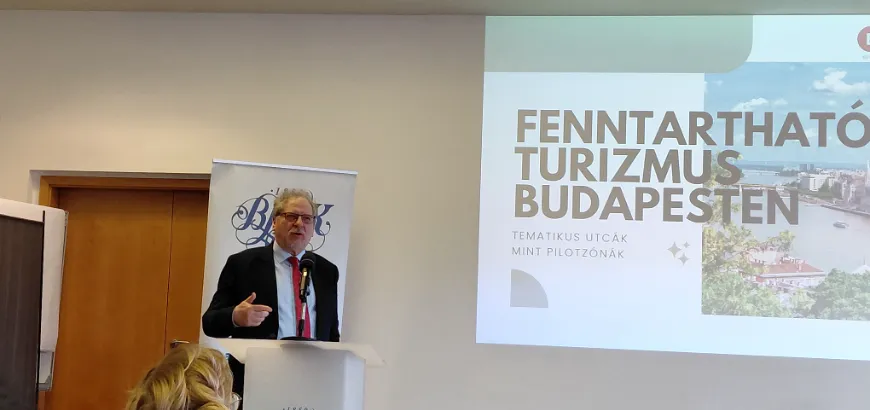
We asked Attila Antal about his presentation at the World Tourism Day 2026 conference organized by the Budapest Chamber of Commerce and Industry, where he shared his thoughts on the topic of “Sustainable tourism in Budapest.” The managing director of BUM spoke about how themed streets could become practical pilot areas for Budapest's new, more sustainable tourism model.
1. Budapest's tourism is often criticized for overcapacity. Where do you think the biggest problem lies today?
The biggest issue is not tourism itself, but its spatial and temporal concentration. The masses of visitors appear in the same neighborhoods during the same periods, while other districts remain underutilized despite having significant cultural, gastronomic, and entrepreneurial potential. This not only deteriorates the quality of life for residents but is also not an economically effective model. Budapest does not need more tourists today, but rather a better organized tourism.
At several national professional forums – most recently at the Tourism Season Opening Gala – it has been mentioned that Hungarian tourism needs to shift from a quantitative to a qualitative approach. Zoltán Guller, the chairman of the board of the MTÜ, identified 12+1 intervention areas. The points mentioned at the Gala practically coincide with what we have been doing on the ground for years. For us, the shift in quality is not a slogan, but a daily operation: how to make streets more livable, balance visitor loads, while strengthening local businesses and communities.
If we look at the 12+1 points, almost every single one is connected to a city-level solution that can be tested in thematic streets – whether it concerns digitalization, training, sustainability, or rethinking attractions.
2. The concept of “thematic streets as pilot zones” frequently appears in your presentation. What does this mean in practice?
Thematic streets are urban micro-ecosystems where culture, commerce, hospitality, and local communities connect naturally. These are ideal grounds for quickly and measurably testing new tourism solutions – whether it be digitalization, visitor management, or community activations. What we try out and works here can later be scaled at urban or even international levels – whether it concerns measuring visitor flows, community programs, or digital developments.
3. How is the role of Shopping Street Management different from that of a traditional urban development player?
We work not on a theoretical level, but on the ground. We are in daily contact with hundreds of small and medium enterprises, cultural players, galleries, and hospitality businesses. We have real data and feedback about what works in a given street and what does not. The BUM is essentially the field execution and feedback system of urban tourism: we link strategic goals with everyday urban operations.
4. Sustainability often remains an abstract concept. How can it be “translated” into the language of businesses and residents?
Sustainability works when it represents tangible benefits. For a business owner, it means digital visibility, more efficient operations, and a new clientele. For residents, it means more livable streets, less congestion, and more community programs. In thematic streets, we can show exactly this: how ESG, digitalization, or data-driven operations can be everyday practice rather than an administrative burden.
True sustainability is not a separate project but a mindset present in every decision. In thematic streets, environmental, economic, and social sustainability is manifested simultaneously, thus reducing overcapacity, strengthening the local economy, and making the streets more livable for residents.
In this sense, we can say that what we do is not only relevant at the urban level but also at the national tourism strategic level, and we are glad that the MTÜ's directions now clearly confirm this.
5. The material emphasizes alignment with EU guidelines. Why is this important for Budapest now?
From 2026, specific European Union funds will become available for smart tourism, cultural, and sustainable urban projects. Budapest can take advantage of these if it already has functional pilots, measurable results, and collaborating local networks. The thematic streets fill exactly this gap: they provide quickly launchable, EU-compatible model areas.
6. What specific pilot projects might be launched in the near future?
We are thinking in several directions. For example, the audit measuring the digital and ESG maturity of SMEs, the “smart street” visitor flow measurement, or the “Living Streets” community-cultural program series. This also includes urban storytelling video and podcast projects, as well as developing artistic-cultural routes. All of these serve economic, cultural, and community goals simultaneously.
7. How can the guiding profession connect to all of this?
Guides are key players in this new model. They are the ones who interpret the city and shape the experience into a story. The thematic streets, cultural routes, and local stories provide an excellent foundation for quality, experience-based guiding. The future guide not only accompanies but designs and directs experiences – in this, we consider them as strategic partners.
8. If you had to summarize in one sentence: what message do you have for decision-makers and the profession?
The future tourism of Budapest will not depend on theoretical strategies but on real urban spaces tested, collaboration-based solutions – and today, thematic streets represent the most tangible laboratory for this.