Student startups would move to the basements of Budapest – the BUM Basement Boost Challenge has concluded.
The first edition of the BUM Basement Boost – Urban Startup Challenge concluded with in-person participation, during which university students developed innovative, commercially viable concepts for the utilization of basement and cellar spaces in Budapest.
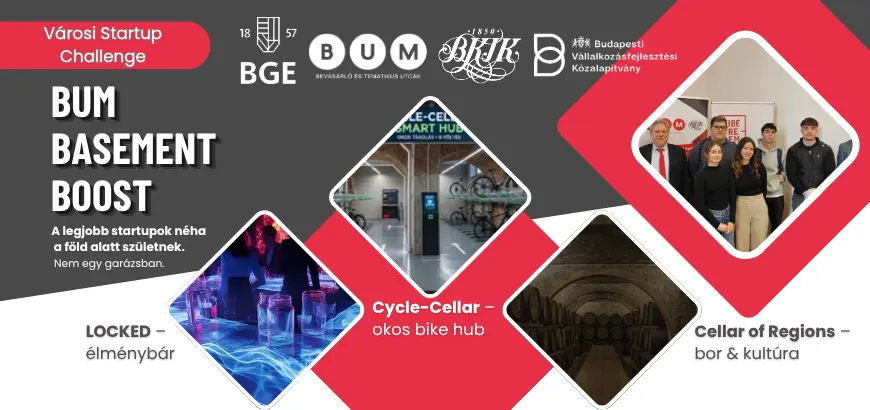
The program is special in that the participants designed new functions for currently existing, underutilized properties, thus not only solving a theoretical task but also finding solutions to specific utilization problems. The event was partnered by the Erzsébetvárosi Ingatlangazdálkodási Nonprofit Kft. (EVIN) and Budapest IX. District, Ferencváros Municipality, Asset Management Office (IX. district). The program was realized as a joint initiative of the Budapest Business School (BGE), the Budapest Business Development Foundation (BVK), the Budapest Chamber of Commerce and Industry (BKIK), and the Shopping Street Management (BUM Nonprofit Kft.). Based on the evaluation of the jury composed of experts, three projects were deemed outstanding: 1. LOCKED – Immersive Story Bar, a story-driven experience bar concept where guests become part of an interactive experience. 2. Cellar of Regions, which showcases Hungarian wine regions through gastronomic and cultural experiences guided by a digital application. 3. Cycle-Cellar Smart Hub, an automated, 24/7 micromobility center for e-bikes and scooters. Several other projects also performed excellently, including the concepts of Fight Club Bar, MycoLab, RagePaint, GreenBase, Luna, and KELVID Marketing Studios. The winning projects demonstrate that the students approached the task from various perspectives – experiential, cultural, and business-oriented. The jury emphasized that the overall competition was extremely strong, and every submitted application contained valuable and thoughtful work. "Very good teams formed, and I think it's particularly good that teams of different sizes worked together. Everyone could find the team composition in which they could be the most effective." – Dr. habil. András Kovács, Deputy Dean, University Professor, Budapest Business School – Marketing Department A particularly important aspect of the professional evaluation was how well the students could think about real locations based on specific market needs. "Most teams actually sought solutions for the given location, considering the environmental conditions and the needs of the target group." – Dr. habil. András Kovács, BGE According to the jury, most of the presented concepts were based on implementable foundations, while important lessons were also articulated. "Ideas varied in terms of market entry barriers and capital requirements, but fundamentally every project is worth further consideration." – Marcell Ilyés, Chairman of the Board, Budapest Business Development Foundation The students' business thinking positively surprised several jury members. "Most teams not only completed an assignment, but truly created a usable business plan, with a well-thought-out target group and market approach." – Dr. Bence Dániel Horváth, Deputy Secretary General, Budapest Chamber of Commerce and Industry Overall, it became clear to the organizers that the students are capable of responding to real business problems. "We saw a particularly strong competition, which was a pleasant surprise for us. Not only did creative ideas emerge, but in many cases the students presented concepts that could also be understood in business terms, and we even encountered solutions that could facilitate networking." – Attila Antal, Managing Director, BUM Nonprofit Kft. Most of the projects were found to be feasible by the organizers. "A significant portion of the projects, upon further consideration, rests on realistic foundations. Compared to work completed in such a short time, several ideas were born that could even be developed into a real business." – Attila Antal, BUM The complex evaluation of the ideas played a key role in the decision. "Viable and unique concepts, responses to 21st-century challenges, as well as the developed business plans and the responses given during the presentations together determined the rankings." – Marcell Ilyés, BVK One of the most important values of the program is that the students did not work in a simulation environment but faced real business and urban challenges. "This program is an excellent opportunity for students to work on real problems and create potentially feasible solutions." – Dr. habil. András Kovács, BGE The organizations behind the initiative – BGE, BVK, BUM, and BKIK – aim to strengthen students' entrepreneurial mindset and contribute to the renewal of urban spaces through such programs. "Such programs develop problem-solving thinking, cooperation skills, and entrepreneurial attitudes while also offering real opportunities for implementation." – Dr. Bence Dániel Horváth, BKIK According to the organizers, the ideas presented could have a real urban impact. "These projects indicate that there is serious potential in currently underutilized spaces. Even if only a few of these are realized, it can have a substantial effect on the urban environment." – Attila Antal, BUM The will for continuation is clear from the organizers and partners as well. "We would be happy to participate in similar initiatives in the future, at the institutional level as well." – Marcell Ilyés, BVK The mood of the day was well summed up by one of the jury's final thoughts: "It was an inspiring day, where we saw that Generation Z young people are capable of providing working solutions to real problems." – Attila Antal, BUM The organizers hope that among the presented concepts, several will be further developed and may even be implemented in the urban spaces of Budapest in the future. Detailed article CAN BE READ HERE!