Showcase Chronicles 2026: improving main streets, new hotspots, and a transforming business mix in downtown Budapest
What do the numbers of vacant commercial properties indicate – and what cannot be read solely from the statistics?
Survey period: July–August 2026
The Shopping Street Management has been tracking the changes in the business inventory of partner streets and districts for years. The survey conducted in the summer of 2026 paints a more mixed picture than the previous two years: in several key areas, the number of vacant shops continued to decrease, while in others, it visibly increased again. Behind the shop fronts, not only tenant changes are occurring, but the entrepreneurial structure in the city center and consumer demand are also transforming.
What does the comparison between 2025 and 2026 show?
The number of vacant business premises in the 17 areas studied increased from 90 to 96 from 2025 to 2026. This is an increase of 6, or 6.7 percent. The situation improved in six locations, remained unchanged in four, and worsened in seven.
However, the balance does not indicate a uniform deterioration. In areas where vacancies decreased, a total of 18 shops found new owners; this was offset by an increase of 24 shops measured in the deteriorating areas. The Belgrád embankment appeared in the survey for the first time in 2026, where we found five vacant business premises, but due to the lack of previous base data, no change can yet be calculated.
In this year's evaluation, therefore, the differing direction by street is more important than the aggregated percentage. Due to the small base values, the percentage change in individual areas can easily be misleading: for example, a single new vacancy increasing from one business to two represents a hundred percent increase. The absolute numbers, the local environment, and the longer time series together provide a meaningful picture.
Where did the favorable trend continue?
This year, the largest improvement was shown by Haris Street, where the number of vacant shops decreased from 13 to 8. This is an important turnaround, as last year's survey indicated a decline right here. The vacancy rate in Király Street decreased from 18 to 14, in Ráday Street from 15 to 12, and in Bartók Béla Boulevard from 8 to 6.
In the broader surveyed Palotanegyed, the number of empty premises decreased from 10 to 7, while in Széll Kálmán Square it decreased from 4 to 3. We found one vacant shop on Fashion Street, two on Liszt Ferenc Square, and one on Lövőház Street, meaning there was no change in these areas. There continues to be no vacant business premises in the Rákóczi Square area. Over the years, however, it is evident that there are shops that have remained vacant for a long time, which are presumably burdened by some legal or ownership issue, as the location would not justify them remaining vacant.
Where has greater pressure appeared?
The most significant deterioration is visible in the Pozsonyi Street area: the number of vacant shops increased from 2 to 10. In the I district's Víziváros, the figure rose from 4 to 11. In Hajós Street, it went from 3 to 6, and in the Mikszáth Square-Krúdy Gyula Street area, it rose from 2 to 4 vacant premises.
Near the University Square, it went from 1 to 2, in Falk Miksa Street, it increased from 6 to 7, while in the Tompa Street-Ferenc Square area, the count rose from zero to two. These data should not automatically be read as qualifications for the entire district: even a few changes in a shorter or smaller section can significantly skew the statistics, while the overall trend may not be outstanding.
Has the favorable trend since 2023 been reversed?
Based on the longer time series, we cannot speak of a simple trend reversal. In the nine streets for which data is available for both 2023 and 2026, the total number of vacant shops decreased from 122 to 64. This represents a decrease of 58 business premises, nearly 48 percent less vacant shopfronts in three years.
The aggregated value of the 15 streets that can be continuously compared from 2024 is also more favorable than two years ago: it decreased from 104 to 87. Therefore, the 2026 measurement rather indicates that the previous broad improvement has stalled and become spatially divergent. Some shopping streets continue to strengthen, while in other areas, new focal points of vacancies have emerged.
From a broader perspective, there is also a gradual but segmentally varying revitalization visible in the non-residential real estate market in Budapest. According to a Colliers analysis presented by the Property Forum for the first half of 2026, the vacancy rate in Budapest's office market has decreased to 12.2 percent, and the vacancy rates have also continued to fall in prime and secondary shopping streets; in contrast, the vacancy rate for Budapest's industrial-logistical properties increased from 12.8 percent to 14.8 percent. The broader market thus shows the same uneven picture: location and property type increasingly dictate where real improvement can be observed.
Source: Property Forum, Hungarian real estate shows gradual recovery, August 11, 2026. https://www.property-forum.eu/news/colliers-reviews-hungarian-real-estate-market-in-h1-2026/21873
What do the new and expanded areas signify?
In the VIII district, the 2025 survey was not limited to Mikszáth Square and Krúdy Gyula Street: we examined several streets in the inner Palotanegyed (Horánszky Street, Bródy Sándor Street, Pollack Mihály Square, Ötpacsirta Street, the pedestrian section of Baross Street, Mária Street). These results will appear in a separate area row in this year's report, allowing for a more accurate trend to be drawn in coming years, and we will also merge these with the data from Mikszáth Square and Krúdy.
Belgrád embankment has been added as a new member, where the first measurement recorded five vacant business premises. This is currently a starting point, not a trend showing improvement or deterioration. The survey of the Margit square is also being conducted for the first time. According to the II district municipality, there are almost no vacant business premises on Margit Boulevard; the detailed survey will also show how representative this positive picture is for the broader district.
What is special about the situation of KultUnio?
KultUnio is not a single street but an entire downtown district on the border of Terézváros and Erzsébetváros, in the area bounded by Andrássy Avenue, Teréz and Erzsébet Boulevard, Rákóczi Road, and Károly Boulevard. Thousands of businesses operate here, so a full survey of the area is substantially different from walking through a shopping street. The district was fully measured for the last time in 2023 and again in 2026 due to its size.
The comparison of the two complete surveys clearly indicates improvement: in 2023, we found 272, while in 2026 we found 230 vacant business premises in the KultUnio area. This represents a decrease of 42, or 15.4 percent. The 230 vacant premises still represent a significant number, but in the scale of the district comprising several thousand businesses, the direction of change is favorable.
On-site experiences suggest that the business profile of the district has significantly transformed in recent years. In areas near Deák Ferenc Square, which have high pedestrian and tourist traffic, there are fewer vacant shops, while the inner streets towards Teréz Boulevard, especially towards Erzsébet Boulevard, are less sought after. Due to the differences within the district, a single aggregate number says very little in this case: the location, traffic, and type of business must also be considered.
What do the shopfronts tell beyond the numbers?
During the survey, we observed the closure of many long-established businesses while numerous new shops opened their doors. Thus, the decrease in the number of vacant premises does not necessarily indicate an unchanged or stable entrepreneurial community: it may occur that the same premises quickly hosts multiple tenants.
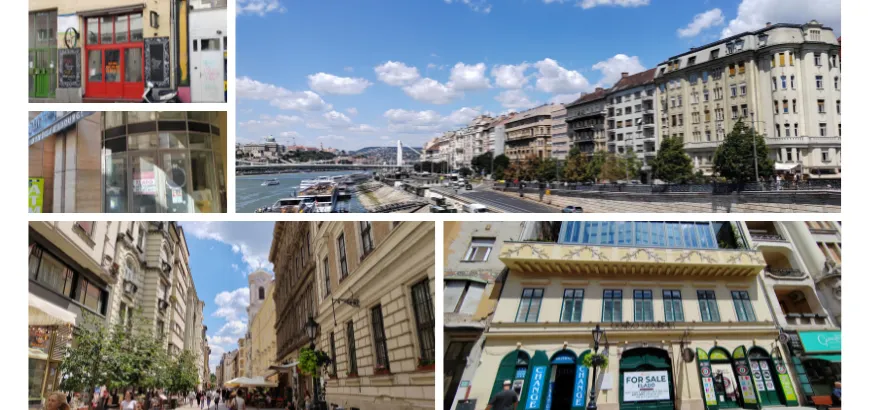
On a positive note from Erzsébetváros, newly renovated building facades have been designed with aesthetically pleasing, fitting shopfronts for the vacant premises. This is a good example showing that temporarily unused ground-floor areas do not need to detract from the street view: with careful design, they can also contribute positively to the appearance of the building and the public space.
Some of the new supply directly responds to the changed consumer demands. In the areas most visited by tourists, many souvenir shops, chimney cake vendors, and eateries offering goulash and lángos have opened. These businesses respond to visible demand, but only time will tell whether the market can sustain so many units with similar profiles in the long term.
The vitality of the district is thus indicated not only by how many shopfronts are vacant but also by how long businesses stay, how diverse the supply is, who they serve, and whether they can build connections between the needs of the local population, workers, and visitors.
How can the situation in 2026 be summarized?
The most important lesson from the 2026 survey is that Budapest's downtown business map is not moving in a single direction. In the areas that have been tracked since 2023, there are still significantly fewer vacant shops than three years ago, but in the past year, the overall value of the comparable areas has slightly deteriorated.
Favorable and unfavorable changes coexist: the improvements in Haris Square, Király Street, Ráday Street, Bartók Béla Boulevard, and Palotanegyed are significant achievements, while the increases measured in the Pozsonyi Street area and Víziváros require attention. The upcoming question is not only whether the vacant premises can be filled, but also with what type of businesses, with what durability, and while creating what local value.
In this, the role of entrepreneurial communities, municipalities, owners, and neighborhood collaborations continues to be significant. The condition of the shopfronts is a quick signal; however, the quality of the community operating behind them is what ultimately determines the resilience of a street or district over the long term.
Vacant business premises tell not only about the city's changes but also offer opportunities for new businesses. Anyone looking for rental business premises in Budapest can browse the current offerings at Kibérelem.hu.
Number of vacant business premises, 2025–2026
The positive sign of change means fewer vacant shops with a negative sign indicating more. There is no previous comparative data for Belgrád embankment.
| Area | 2025 | 2026 | Change |
| Bartók Béla Boulevard | 8 | 6 | -2 |
| Belgrád embankment | - | 5 | - |
| University Square | 1 | 2 | +1 |
| Falk Miksa Street | 6 | 7 | +1 |
| Fashion Street | 1 | 1 | 0 |
| Hajós Street | 3 | 6 | +3 |
| Haris Square | 13 | 8 | -5 |
| Király Street | 18 | 14 | -4 |
| Liszt Ferenc Square | 2 | 2 | 0 |
| Lövőház Street | 1 | 1 | 0 |
| Mikszáth Square, Krúdy Gyula Street | 2 | 4 | +2 |
| Palotanegyed | 10 | 7 | -3 |
| Pozsonyi Street | 2 | 10 | +8 |
| Ráday Street | 15 | 12 | -3 |
| Rákóczi Square | 0 | 0 | 0 |
| Széll Kálmán Square | 4 | 3 | -1 |
| Tompa Street–Ferenc Square | 0 | 2 | +2 |
| I. district Víziváros | 4 | 11 | +7 |
Source: BUM business survey, July–August 2026; comparison with 2025 data