From research to collective action – the Living Downtowns program has reached another milestone.
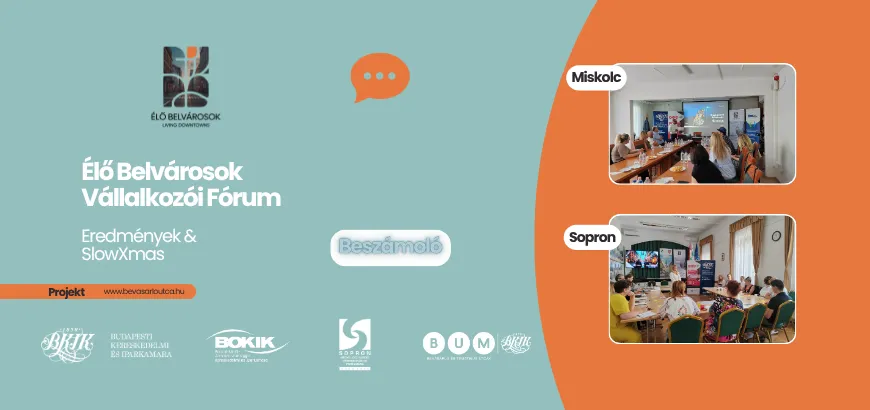
On August 11 in Miskolc and August 12 in Sopron, the Living Downtowns program continued with online entrepreneurial forums. Following the spring research, focus group consultations, and the personal entrepreneurial forums in July, this time we presented the results of the investigations conducted so far and the development opportunities that emerged from them. The goal for the upcoming period is to create local collaborations and specific action directions based on the acquired knowledge.
The Living Downtowns program has examined the situation of the downtown areas in Miskolc and Sopron over the past months in several stages. The analysis was supplemented by entrepreneur questionnaires and focus groups, as well as previous local research, location and purchasing power analyses, and urban strategic documents.
During the entrepreneurial forums in July, good practices and potential solutions came to the fore: in Miskolc, participants heard about the opportunities for city branding and community building through the example of Kolorcity, while in Sopron, international tourism and urban development experiences were shared.
The online meetings in August showcased the overall picture emerging from the data collected so far and what this might mean for the future of the two downtowns.
Miskolc: there is visitor traffic – the challenge is to create greater local economic value from it
In the case of Miskolc, it is particularly valuable that we have results from several studies carried out at different times and with varying methodologies. The City-Partner strategy of the University of Miskolc, the location analysis by Marketing Resolution, the entrepreneurial research and focus group by Urbavis, as well as the 2025 residents' survey conducted by the Miskolc Downtown Circle with over 200 respondents all indicate the same problems and opportunities.
According to the analysis by Marketing Resolution, there are nearly 13,750 active businesses in Miskolc, and the city’s purchasing power index is 100.6, which practically corresponds to the national average. In addition, Miskolc is a significant center for employment, education, and tourism.
This leads to an important conclusion: the problems of the downtown area cannot simply be explained by a lack of purchasing power. The real question is how much of the existing purchasing power is actually realized in the downtown area and how much goes to shopping centers, online retailers, or other parts of the city.
The entrepreneurial research clearly demonstrated the challenges of everyday operations. Entrepreneurs reported a decrease in pedestrian traffic, unpredictable customer traffic, a growing number of vacant commercial spaces, high operational costs, parking and accessibility problems, as well as deficiencies in public spaces and urban aesthetics. A recurring issue is the weakness of entrepreneurial cooperation and joint marketing.
Miskolcians visit the downtown area – but they do not necessarily spend money there
The residential survey conducted by the Miskolc Downtown Circle provides a particularly interesting picture. Nearly 56 percent of respondents visit the downtown area multiple times a week or daily, while the frequency of purchases is lower than that.
The pedestrian street is primarily used for dining, coffee-drinking, shopping, and administration, with an average purchase value of around 10,000 forints, while the proportion of higher value purchases is low. The vast majority of respondents consider supporting local businesses important.
This suggests that in Miskolc it is not necessarily about bringing more and more visitors to the downtown area first. An equally important task is to encourage the people who are already there to spend more time in the city center, utilize more services, return more frequently, and choose local businesses to a greater extent.
Comparing the previous City-Partner strategy with the current research highlighted another important issue: the situation of vacant commercial spaces has been a recurring question for over a decade, along with the lack of joint marketing, weakness in entrepreneurial cooperation, parking issues, regular programming, and the absence of a coordinating entity.
Thus, the diagnosis is largely known. The next step is action.
What can be built upon in Miskolc?
Alongside the current situation, the city's strengths are also important. The historical downtown, significant cultural life, the University of Miskolc, the presence of Bosch and other large companies, the tourist allure of Lillafüred and Miskolctapolca, an active hospitality sector, and entrepreneurial communities like the Miskolc Downtown Circle and SOHO provide a solid foundation.
One of the tasks for the upcoming period is therefore to explore how these existing values can be combined to create a common downtown strength and a more visible offering.
Based on the research, potential directions include establishing a regular Downtown Forum and a consultation platform for the municipality and entrepreneurs, joint marketing and event calendars, mapping vacant commercial spaces and utilizing pop-ups, a shared online presence, and organizing traffic-increasing thematic programs.
Sopron: strong assets that need better interconnection
Sopron starts from a completely different situation. The historical downtown is simultaneously an identity bearer, a tourist attraction, and an entrepreneurial space, while the city's border location creates a unique economic environment.
The situation in Sopron was examined based on the entrepreneurial research by Urbavis, the location analysis by Marketing Resolution, as well as the city's Sustainable Urban Development Strategy and Economic Program.
The location analysis indicates that there are 6,124 businesses in Sopron, of which 3,731 are individual businesses and 2,393 are company businesses. Services, tourism, the border location, light industry, the knowledge base of the University of Sopron, and the M85 expressway connection are all important economic assets.
However, the 76.9 purchasing power index in the case of Sopron must be interpreted with particular caution. In the city’s daily life, employment, income, and consumption linked to Austria are significant. This means that it is worth examining not only the local purchasing power but also where the residents of Sopron spend their available income and what offerings, services, or experiences could retain a larger portion of it locally.
Entrepreneurs perceive a complex problem system
Sopron entrepreneurs reported decreasing and more unpredictable customer traffic, a decline in tourism – especially among foreign visitors – as well as the workforce and purchasing power drain caused by Austria and Vienna.
These challenges are compounded by parking and accessibility difficulties, high operational costs and rental fees, and problems in retaining skilled and young labor. Currently, entrepreneurial collaborations are mainly based on personal relationships, with few joint marketing campaigns and coordinated programs. The research also highlighted issues regarding the usability, shading, and quality of public spaces.
However, an important positive aspect is that entrepreneurs are open to joint actions, cross-marketing, regular consultations, and establishing more organized downtown collaboration.
One of the key lessons from the situation in Sopron is that there is no single problem whose solution would single-handedly revive the downtown area. Accessibility, experience, offering, communication, and cooperation all simultaneously influence its functioning.
Sopron still needs to survey its population
A significant difference from the situation in Miskolc is that there is currently no fresh, specifically downtown-focused research available in Sopron.
Therefore, it is worth comparing the entrepreneurial experiences with the opinions of Sopron residents in the next research phase. Among other things, we want to find out how often and for what purpose residents use the downtown and Várkerület, what businesses and services they miss, what prevents them from shopping more locally, and what programs or new functions would encourage them to return more often.
According to the Living Downtowns approach, a well-functioning downtown’s primary foundation is the local community. If residents of Sopron regularly use, feel ownership, and bring life to the downtown area, it also strengthens its tourism appeal.
Sopron does not start from scratch either
The historical and architectural environment, the Várkerület, the Lővérek, and the Fertő region, cultural heritage, wine and gastronomy culture, and the already existing tourism identity are all assets that can be built upon. This is complemented by the knowledge base of the University of Sopron and the border economic environment.
Therefore, Sopron does not need to invent a new identity. It should rather connect and make more visible the existing values, utilizing them better in the everyday life of the downtown area.
In the short term, therefore, among other things, there can be a new or revitalized collaboration among downtown businesses, regular forums, a joint event calendar, residential and tourism marketing campaigns, cross-marketing, thematic programs, more active involvement of tourism actors, digital marketing training, and testing parking incentives on the agenda.
One of the important professional tasks for the upcoming period will also be to implement the community research.
SlowXmas: one of the first joint actions
In the second part of the online forums, we presented the SlowXmas 2026 program to entrepreneurs from both cities, which connects Miskolc and Sopron alongside Budapest from November 25 to December 24.
SlowXmas is more than just a series of events. It is a citywide initiative that encompasses the entire Advent season, aiming to shift the focus from the shopping rush to quality time, personal encounters, cultural experiences, and local values – while bringing new visitors to the downtown and making businesses there more visible.
The essence of the model is cooperation. The participating stores, eateries, workshops, cultural, and community spaces organize Advent programs that fit their character. This could be a concert, exhibition, workshop, tasting, conversation, family program, Advent walk, or other personal, place-based experiences.
Individual programs will remain independent while being included in a common program calendar and communication. Thus, a larger urban story can emerge from many smaller local initiatives – connecting three cities by 2026.
The model's viability is supported by results from previous years. In 2025, alongside eight shopping and themed streets in Budapest, Miskolc also joined with nearly a hundred businesses and around a thousand programs. The community media campaign reached nearly 1.7 million people and the initiative received another Marketing Diamond Award, making SlowXmas a six-time award-winning program series.
This year’s goal is that the businesses of Miskolc and Sopron can also become active program hosts in this cooperation.
The research is not concluded – now the focus is on utilizing the results
With the August online forums, the Living Downtowns program has reached an important milestone. In recent months, we have collected and compared the available data, listened to entrepreneurs, learned about domestic and international best practices, and started to outline potential development directions.
In the upcoming period, practical utilization will be the focus.
This autumn, the III. BUM Workshop Festival and SlowXmas will provide opportunities for businesses in Miskolc and Sopron to participate in joint programs that increase traffic and visibility. At the same time, local entrepreneurial and institutional collaborations must continue to be built.
In Sopron, one new direction is the collaboration being prepared with the University of Sopron, in which students can engage in researching real downtown problems and later developing solution proposals.
The final professional outcome of the process will be the creation of a local action plan in both cities. These plans will not simply summarize what the problem is, but also outline what can be done, with whom, over what timeframe, and what the first steps will be.
The situations in Miskolc and Sopron are different, but the work done so far clearly shows a common lesson: a downtown’s renewal cannot be expected from a single large project. Research, local business communities, ongoing dialogue, joint programs, and long-term cooperation are necessary.
The next phase of the Living Downtowns program is already about this collective action.